

On-Demand Breastfeeding: The Feeding Approach Experts Recommend

On-demand breastfeeding, feeding your baby whenever they show hunger cues rather than by the clock, is the approach most major health organizations recommend for healthy infants. It works with your body's natural supply-and-demand system and meets your baby's changing needs. Most newborns feed multiple times in 24 hours, typically frequent sessions throughout the day and night, and both the CDC and WHO back this pattern. If your baby is feeding far less than that or seems unsatisfied after most feeds, it's worth a call to a lactation consultant.
TL;DR:
Most newborns should feed 8 to 12 times in 24 hours, with feeding every 1 to 3 hours, and not going longer than 4 hours without a feed.
Early hunger cues include rooting, hand-to-mouth motions, lip smacking, and alertness, which help facilitate easier latching and a more effective feed.
Maintaining a wide, deep latch and skin-to-skin contact after birth supports milk transfer, supply, and efficient nursing.
Preterm or low birth weight infants require a modified approach that combines feeding cues with scheduled safety checks and closer weight monitoring.
On-demand breastfeeding usually resolves common issues like engorgement and oversupply, but persistent pain or blocked ducts benefit from professional lactation support.
Table of Contents
How to breastfeed on demand: latch, positioning, and night feeds
What a lactation counseling visit with Thriving Joy actually looks like
Handling oversupply, engorgement, and other feeding challenges
How on-demand feeding affects your rest, and how to protect it
The gap between the guidance and what actually helps at 3 a.m.
What on-demand breastfeeding means and why it helps
On-demand breastfeeding, also called responsive feeding or cue-based feeding, means nursing your baby whenever they signal hunger instead of waiting for a set clock time. It sounds simple, but it's rooted in real physiology. Your body produces milk based on a feedback loop: the more often and effectively milk is removed from the breast, the more your body makes. Skip feeds or stretch them out, and your supply gets the message to slow down.
This is why a rigid three or four hour schedule can backfire in the early weeks. A systematic review of infant feeding patterns found that baby-led feeding is the approach recommended in clinical guidance, largely because it lets the infant's own demand drive supply. The review also notes that randomized trials comparing scheduled and on-demand feeding directly are still limited, so some of what we know comes from physiology and clinical observation rather than head-to-head trial data. Even so, the guidance is consistent.
Both the World Health Organization and the American Academy of Pediatrics recommend exclusive breastfeeding for about the first six months, followed by continued breastfeeding alongside solid foods for up to two years or beyond, for as long as it works for you and your baby.
Feeding this way offers more than nutrition:
Supports and protects your milk supply through consistent removal
Meets your baby's actual hunger and comfort needs, not an estimated one
Builds bonding through frequent, close contact
Provides comfort during growth spurts, teething, or illness
How to read hunger cues and know how often newborns feed
Crying is a late hunger cue, not the first one. By the time your baby is crying, they've usually already tried several quieter signals to get your attention.
Watch for these earlier cues instead:
Rooting – turning the head and opening the mouth when a cheek or lip is touched
Hand-to-mouth movements – bringing fists or fingers up toward the face
Lip smacking or sucking motions – even without anything in the mouth
Increased alertness and movement – stirring, stretching, or general restlessness
Catching these early cues makes latching easier, since a calm baby nurses more effectively than a frantic, crying one.
Newborns typically feed 8 to 12 times in a 24 hour period, roughly every 1 to 3 hours, according to the CDC. In the early weeks, most babies shouldn't go longer than about 4 hours without feeding, even overnight.
Frequency isn't always steady. Cluster feeding, when a baby wants to nurse almost continuously for a few hours, often in the evening, is a normal part of the pattern, and growth spurts around 2 to 3 weeks, 6 weeks, and 3 months can temporarily push feeds closer together as your baby signals your body to ramp up supply.

You can tell your baby is getting enough by watching for audible swallowing during feeds, a steady climb back to birth weight by 10 to 14 days, and a growing number of wet and dirty diapers each day.
How to breastfeed on demand: latch, positioning, and night feeds
Getting the mechanics right makes on-demand feeding sustainable rather than exhausting. Here's how to set up each feed for success.
Positioning and latch:
Hold your baby tummy-to-tummy with you, so they don't have to turn their head to reach the breast
Line up your baby's nose with your nipple rather than centering the mouth on it
Wait for a wide, open mouth (like a yawn) before bringing baby to breast, not breast to baby
Aim for the chin to touch the breast first, with the nose free to breathe
Look for flanged (outward) lips and more areola visible above the top lip than below
A wide, deep latch does two things at once: it transfers milk more efficiently and it protects your nipples from the friction that causes pain; for practical tips and photos, see how to get the perfect latch. Research from the Children's Hospital of Philadelphia also points to skin-to-skin contact right after birth and in the early weeks as a way to stimulate your baby's feeding reflexes and support your milk-production response.
During the feed: let your baby finish the first breast on their own, they'll often unlatch, slow down, or fall into a loose, sleepy suck when they're done. Offer the second breast if they still seem interested. Burp gently between sides and after feeding, though not every baby needs it.
Pro Tip: If your baby seems to fall asleep within a minute or two of latching, try compressing your breast gently during pauses in sucking. It often restarts active swallowing and helps them get a fuller feed instead of just comfort-sucking at an empty breast.
Night feeds and separation: overnight, keep the room dim and your movements slow to avoid overstimulating your baby back to full alertness. If you're separated from your baby for work or a hospital stay, matching your pumping frequency to their usual feeding pattern, roughly every 2 to 3 hours at first, protects your supply better than a couple of long sessions a day.
Quick troubleshooting:
Shallow latch causing pain: break the seal gently with a clean finger and relatch
Persistent nipple pain or visible cracking: this isn't normal and deserves a lactation consultant's eyes, not just more time
If you're exclusively breastfeeding, most guidance suggests holding off on bottles or pacifiers until nursing is well established, generally around 3 to 4 weeks
When to get help: red flags and where to find support
Most feeding hiccups are fixable with a small adjustment. But a few signs mean it's time to call for backup rather than wait it out.
Reach out to your pediatrician or a lactation consultant if you notice:
Fewer than about 8 feeds in 24 hours past the first few days
Fewer than 3 wet diapers by day 3, or continued weight loss after day 5
Nipple pain that persists through the whole feed, or visible cracking or bleeding
A baby who seems constantly unsettled after feeds or rarely seems to swallow
An International Board Certified Lactation Consultant (IBCLC) can watch a full feed and often spot in minutes what's hard to diagnose on your own. You can find one through your hospital's lactation service, a local WIC breastfeeding program, or Thriving Joy's lactation counseling support. These kinds of hands-on services genuinely improve breastfeeding outcomes for families who use them.
If you're taking any medication while breastfeeding, the LactMed database is a reliable way to check compatibility before assuming you need to pause nursing.
What a lactation counseling visit with Thriving Joy actually looks like
Thriving Joy's team blends lactation counseling with pediatric feeding therapy, which means support doesn't stop at "here's a latch tip and good luck." The practice takes a family-centered approach that looks for the root cause of a feeding struggle, whether that's positioning, oral function, or supply, rather than offering a generic fix.
A typical visit might include:
Hands-on latch correction, watched and adjusted in real time
A short-term pumping plan if supply needs a boost or baby needs supplemental milk
Relay feeding strategies when a baby tires before finishing a feed
Referral into feeding therapy if oral motor issues are contributing to the struggle
To get the most from an appointment, bring a recent feeding log, any weight records from your pediatrician, and your pump if you're using one. Good questions to ask include how your baby's latch looks compared to ideal, whether your supply matches their needs, and what a realistic timeline for improvement looks like.
If you're pregnant and want to get ahead of feeding challenges before birth, prenatal lactation consultation is worth exploring too.
Feeding preterm or low birth weight babies on demand
On-demand feeding works differently for preterm and low birth weight infants, and it usually needs a modified approach rather than a straight application of newborn norms. Preterm babies often lack the stamina or coordinated suck, swallow, and breathe pattern that full-term infants have, so they may not reliably wake or cue for feeds even when hungry.
For these babies, many neonatal teams recommend a hybrid approach: watching the clock as a safety net (waking baby if too much time has passed) while still following hunger cues when they do appear. A preterm baby might tire out halfway through a feed and need to be woken again shortly after to finish, rather than following the "let them lead completely" model used with full-term newborns.
Weight gain gets monitored more closely in this group, often with more frequent pediatrician or specialist visits, because a low birth weight baby has less reserve to draw on if intake falls short. Skin-to-skin contact matters even more here. It helps stimulate feeding reflexes in babies who may otherwise seem sleepy or disengaged at the breast.
If your baby was born preterm or with a low birth weight, working with a lactation consultant who has NICU or preterm feeding experience specifically is worth prioritizing over general newborn guidance. The stakes around adequate intake are simply higher, and a modified feeding plan protects both growth and your milk supply.
Common myths about on-demand breastfeeding, debunked
A lot of outdated advice still circulates about feeding on a schedule, and most of it doesn't hold up against current guidance.
Myth: Feeding on demand spoils babies or creates bad habits. Newborns can't manipulate you. Frequent feeding in the early months is a biological need, not a behavior to correct.
Myth: If a baby feeds often, your milk must be low quality or insufficient. Frequent feeding is usually a sign of normal newborn stomach capacity (small) paired with fast-digesting milk, not a supply problem. Cluster feeding during growth spurts is expected, not a red flag on its own.
Myth: You should stretch out feeds to help baby "sleep through the night" sooner. Restricting feeds in early infancy can undercut milk supply and doesn't reliably improve sleep. Sleep consolidation tends to happen developmentally, not through feeding restriction.
Myth: On-demand feeding means you can never predict a pattern. Most babies do settle into a loose rhythm over weeks, just one they set rather than one imposed by a clock. Responsive feeding and predictability aren't opposites.
Myth: Pacifiers or bottles need to be avoided completely for on-demand feeding to work. The concern is mainly about timing, introducing them before breastfeeding is well established, generally around 3 to 4 weeks, rather than permanent avoidance.
Moving from a feeding schedule to on-demand breastfeeding
If you started on a schedule, whether by choice, hospital routine, or advice from an earlier pediatrician, you can shift toward on-demand feeding without a jarring transition.
Start by loosening the schedule rather than abandoning it outright. If you've been feeding every 3 hours by the clock, begin offering the breast at the first hunger cue you notice within that window instead of waiting for the timer. Most babies will naturally start cueing more often once they realize feeds are available sooner.
Track feeds loosely for about a week during the transition, not to control the schedule, but to confirm you're still landing somewhere in that 8 to 12 feed range per day. A sudden drop below that number as you loosen the schedule is worth mentioning to your pediatrician.
Expect some adjustment on both sides. Your baby needs to learn that hunger cues get a response, and you need to recalibrate your sense of "normal" feeding frequency, which often feels like a lot more often than a strict schedule allowed. This is common and typically settles within a week or two.
If the transition triggers engorgement or discomfort because your body adjusted to the old schedule's spacing, that's a normal response to changing demand and usually resolves as your supply recalibrates to the new pattern.
Handling oversupply, engorgement, and other feeding challenges
On-demand feeding usually helps regulate supply naturally, but a few challenges show up often enough to plan for.
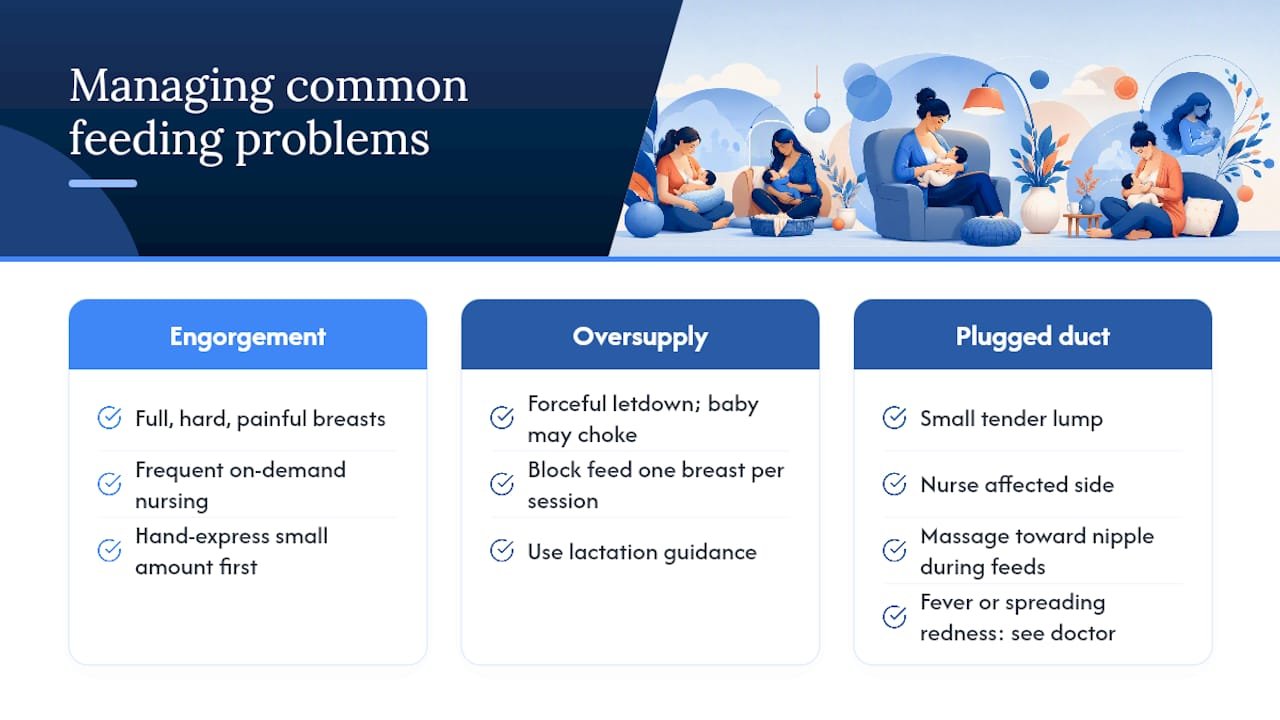
Engorgement, when breasts become overly full, hard, and sometimes painful, is common in the first week as your milk transitions in. Frequent, on-demand nursing is actually the primary fix here, since removing milk regularly prevents the buildup from worsening. If your baby struggles to latch onto an overly firm breast, expressing a small amount by hand first can soften the area enough for a proper latch.
Oversupply looks different: too much milk, sometimes with a forceful letdown that causes baby to gulp, choke, or pull off repeatedly. Feeding on demand from both breasts isn't always the right move here. Some parents find that nursing from just one breast per feeding session (block feeding) for a short period helps regulate supply down to match demand, though this should generally be done with lactation guidance rather than on your own, since done incorrectly it can tank supply too far.
Plugged ducts, small tender lumps from a blocked milk duct, often respond to continued nursing on the affected side, along with gentle massage toward the nipple during feeds. A plugged duct that comes with fever or spreading redness may be progressing toward mastitis and needs medical attention promptly.
The common thread across all three: on-demand feeding is rarely the cause of these problems, and it's usually part of the solution once the underlying issue (positioning, timing, or oversupply) gets addressed directly.
How on-demand feeding affects your rest, and how to protect it
Frequent overnight feeds are the part of on-demand breastfeeding that wears parents down fastest, and it's a legitimate concern, not something to just push through silently.
A few strategies make a real difference without abandoning responsive feeding. Keep nighttime setups simple: a bedside setup with water, a burp cloth, and dim lighting within reach means you're not fully waking up for every feed. Feed on the side you're already facing when possible, since minimizing movement helps you fall back asleep faster afterward.
If you have a partner or support person, dividing labor around the feed itself, even if they can't nurse, matters more than it might seem. Bringing baby to you, handling diaper changes, and resettling baby afterward can meaningfully cut into how disrupted your own sleep gets, even if the feed count stays the same.
Pumping to allow a partner to handle one overnight feed occasionally can also help, provided your supply is well established and you pump around the same time to maintain the demand signal. This isn't necessary for everyone, but it's a reasonable option if you're running on fumes.
Daytime naps that match your baby's sleep, even briefly, do more for cumulative rest than trying to catch up on one long stretch. If exhaustion feels unmanageable rather than just difficult, that's worth raising with your pediatrician, since persistent extreme fatigue can also signal something like postpartum depression that deserves its own support.
The gap between the guidance and what actually helps at 3 a.m.
Public health guidance on breastfeeding is solid. The CDC and WHO numbers hold up, and the physiology behind supply and demand isn't controversial. Where the conventional advice falls short is in translation: telling a parent to "feed on demand" doesn't tell them what a hunger cue looks like at 2 a.m. when they're exhausted, or how to tell normal cluster feeding from a real supply problem.
What gets underrated is how much a single well-timed hands-on session with a lactation consultant can shortcut weeks of guesswork. Parents often wait until there's a crisis, cracked nipples, a weight check that raises eyebrows, before asking for help, when an early visit in week one or two often prevents the crisis entirely.
If there's one thing to prioritize, it's this: trust the early cues over the clock, but don't treat "figuring it out alone" as a badge of honor. Watching a feed in person catches problems that no amount of reading fixes on its own. That combination, responsive feeding plus a willingness to get a second set of eyes early, is what actually moves the needle, more than any single positioning trick or schedule hack ever will.
— Jamie
This article is general information, not a substitute for advice from a qualified doctor. Consult a qualified healthcare professional about your own circumstances before acting on anything here.