

50 Words by 24 Months? When It’s Autism vs Language Delay

Most late-talking toddlers have an isolated language delay, not autism. Autism becomes the likelier explanation when a child's language differences show up alongside limited eye contact, little interest in shared play, few gestures, or a loss of skills they once had. If you're seeing those combined patterns, your first calls are your pediatrician and an audiologist, with a speech-language evaluation to follow. The CDC recommends autism screening at 18 and 24 months, and earlier evaluation is always reasonable if something feels off.
TL;DR:
Most late-talking toddlers have an isolated language delay and typically develop social skills like eye contact and gestures.
Autism is more likely if social engagement is limited, gestures are absent, pretend play is reduced, or regression occurs after initial skills.
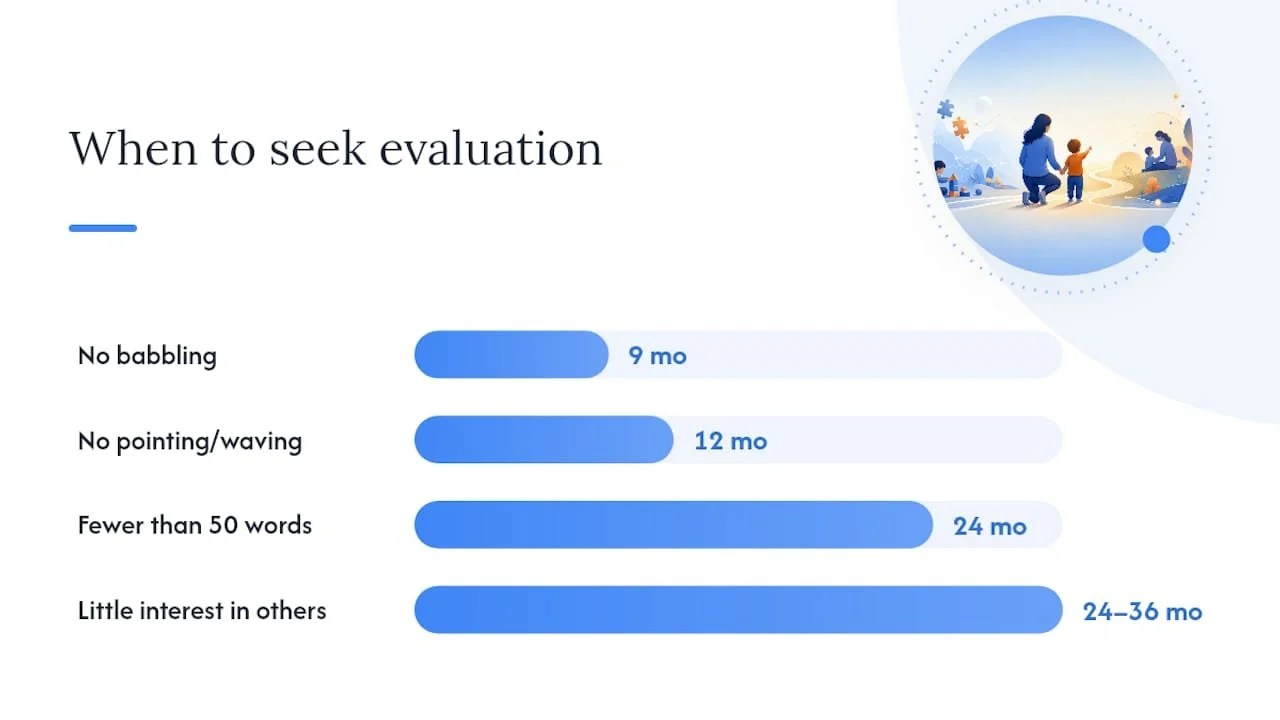
Routine screening at 18 and 24 months helps identify early signs, but immediate evaluation is recommended if there is no babbling by 9 months or fewer than 50 words by 24 months.
Diagnosis involves audiology testing, speech-language assessment, and observation of social behaviors to distinguish autism from language delay.
Early intervention, including speech therapy and parent coaching, significantly improves outcomes, especially if started before communication issues deepen.
Support Your Child’s Communication
Thrivingjoy provides family-centered speech therapy for children from birth through elementary school, with guidance tailored to each child’s needs.
Table of Contents
Autism vs Language Delay: What to Look for at Home
The clearest way to separate the two starts with a simple question: is your child's whole way of connecting with people different, or is it mainly their words that are lagging?
Children with an isolated language delay, sometimes called developmental language disorder (DLD) or a "late talker" profile, tend to point at what they want, make eye contact, wave bye, and pull you over to show you something exciting. They engage socially in every way except through spoken words. Kids on the autism spectrum often show that same social engagement piece missing or muted, even when their vocabulary looks fine on paper.
Here's what tends to separate the two profiles in daily life:
Joint attention. A toddler with DLD will look where you point and then look back at you to share the moment. A child with autism-related differences may not follow your gaze or may not check back in with you at all.
Gestures before words. Late talkers usually compensate with pointing, reaching, and pantomime. Limited gesture use, even when speech is absent, is one of the most consistent nonverbal markers clinicians look for.
Pretend play. Feeding a stuffed animal or "driving" a block like a car shows symbolic thinking. This kind of play is often reduced in autism, even when overall play skills otherwise seem age-appropriate.
Receptive vs. expressive gaps. A child with DLD often understands more than they can say. A child with autism may have a mix of receptive and expressive difficulty, plus trouble understanding tone, sarcasm, or multi-step directions.
Speech quality. Echolalia (repeating phrases from shows or past conversations), flat or sing-song prosody, and difficulty holding a back-and-forth exchange point toward autism-specific language differences rather than a simple vocabulary lag.
The numbers help put this in perspective. Roughly 1 in 36 children is diagnosed with autism, while developmental language disorder affects closer to 1 in 14 kindergartners. If your toddler is behind on talking, the math is on your side: isolated language delay is far more common than autism. That said, the NIDCD notes that autism frequently comes with both receptive and expressive language deficits layered on top of social-communication differences, which is exactly why looking at the whole picture matters more than word count alone.
When Should You Get an Autism Screening?
The American Academy of Pediatrics and the CDC both build autism screening into routine well-child visits, and the timeline is worth knowing by heart. Pediatricians screen every child for autism at 18 months and again at 24 months, regardless of whether a parent has raised a concern. These aren't diagnostic tests; they're structured questionnaires designed to catch differences early, before "wait and see" turns into a missed year of services.
Certain signs should move you past routine screening and into an active conversation with your child's doctor:
No babbling by 9 months. Babbling is the foundation speech sounds build on; its absence is worth flagging early.
No pointing or waving by 12 months. These early gestures are some of the first social-communication milestones to watch.
Loss of any previously acquired skill, at any age. A child who stops using words they once said, stops waving, or withdraws from play they used to enjoy needs urgent evaluation. Regression is a well-documented red flag and is not something to monitor quietly for another few months.
Little interest in other children or caregivers by 24 to 36 months. Preference for solitary play over shared play, especially combined with language delay, deserves a closer look.
Waiting has a real cost. Healthychildren, and the NICHD points out that early intervention services work better the sooner they start. A three- or six-month delay in getting evaluated can mean a three- or six-month delay in getting help that actually moves the needle.
What Happens During an Autism or Language Evaluation?
A thorough evaluation almost always starts somewhere other than autism itself: your child's ears. Clinical guidance calls for audiology testing any time a speech or language concern comes up, because undiagnosed hearing loss can look almost identical to a language delay in a toddler who otherwise seems socially engaged. Ruling that out first saves everyone time.
From there, the pathway typically includes:
A speech-language pathologist (SLP) evaluation. This includes standardized language testing, an oral-motor exam to check muscle function for speech, and direct observation of how your child uses language socially, not just how many words they know.
A developmental pediatrician or pediatric neurologist. For children showing autism-related signs, this specialist coordinates the broader diagnostic picture and often leads the formal ASD evaluation.
A psychologist trained in autism assessment. Standardized tools assess social communication, play, and repetitive behavior patterns directly, comparing what your child does against expected patterns at their age.
Occupational therapy input, when sensory or motor differences are also part of the picture, since these frequently overlap with communication challenges.
What separates an ASD finding from a DLD finding usually comes down to those nonverbal social behaviors more than the words themselves. Clinical comparisons of toddlers matched on the same expressive language level found that children with ASD showed weaker eye gaze regulation, less pretend play, and fewer back-and-forth exchanges than children with DLD. Two kids can say the exact same 20 words and still land in different diagnostic categories, because the diagnosis hinges on how they use language socially, not just how much of it they have. You can read more about what happens during a speech-language evaluation to know what to expect at that first appointment.
What Early Intervention and Therapy Look Like
Therapy goals shift depending on which profile fits your child, even though both often start with speech-language therapy as the front line.
For a child with isolated language delay, sessions usually target vocabulary growth, combining words into longer sentences, and grammar patterns like past tense or plurals. Progress is often steady and measurable within a few months.
For a child with autism-related language differences, therapy tends to widen its focus beyond vocabulary into pragmatics: teaching a child to request, protest, share attention, and take conversational turns. Joint attention itself often becomes a direct treatment target rather than an assumed skill.
Families will typically encounter a mix of these formats:
Direct one-on-one SLP sessions, usually weekly to start, focused on specific language or pragmatic goals.
Parent-mediated coaching, where a therapist teaches you strategies to use during everyday routines like mealtime or bath time.
Small-group social communication therapy, useful once a child has basic language and needs practice using it with peers.
More intensive programming, for children with significant delays across multiple areas, sometimes combining speech, occupational therapy, and behavioral support.
Pro Tip: Read the same three or four books on repeat for a few weeks instead of rotating your child's library constantly. Repetition gives them multiple chances to predict, imitate, and eventually produce the words and phrases you're modeling.
Family involvement isn't a nice extra; it's one of the more reliable levers in outcomes. Parent-mediated intervention and coaching have been shown to improve how well new skills carry over into daily life compared with clinic-only sessions. Whichever profile fits your child, the prognosis tends to improve the earlier families get connected to the right kind of support. For more ideas you can start using today, this guide on building better communication skills walks through simple daily routines that reinforce therapy goals.
Your Next Steps: Track, Ask, and Refer
Start keeping a simple log now, even a notes app works fine. Record the date, the words your child says, the gestures they use, and specific examples of how they interact with you or other kids.
Bring your log to your next pediatric visit and ask directly: "Based on what you're seeing, does this look more like a language delay or something on the autism spectrum?"
Ask your SLP what specific pragmatic skills they're assessing, not just word count, since that distinction shapes the whole evaluation.
Contact your local early intervention program or school district directly if your pediatrician hasn't already referred you. You don't need to wait for a diagnosis to start this process. Reviewing early warning signs of speech delay beforehand helps you describe concerns clearly. Parents also find age-by-age milestone checklists useful for organizing what to track.
Call for an evaluation immediately, without waiting for a scheduled well-visit, if you notice any regression or sudden loss of previously acquired skills.
How Family-Centered Clinics Support Both Diagnoses
A good evaluation looks at more than isolated words. Thrivingjoy's approach starts with a whole-child assessment that considers oral-motor function, feeding patterns, sensory sensitivities, and the rhythms of your family's daily routines, because these pieces often connect in ways a narrow speech test would miss.
From there, goals get built around your child specifically, whether that means expanding vocabulary for a late talker or building joint attention and pragmatic skills for a child showing autism-related differences. Parent coaching is woven into sessions from the start, not added as an afterthought, so what happens in therapy actually shows up at snack time, bath time, and bedtime.
This combination tends to matter most in the early years:
Screening for feeding or oral-motor overlap that sometimes accompanies communication delays
Therapy goals tailored to each child rather than generalized approaches
Coaching to support parents in reinforcing strategies between sessions
Collaboration with pediatricians and other specialists involved in your child's care
A Clinician's Brief Message to Worried Parents
If you've spent the last few weeks googling every difference between your toddler and the kid next door, you're not overreacting. Trust the pattern you're seeing, not just the worst-case scenario your search history keeps surfacing. Write down what you're noticing, bring it to your pediatrician, and ask for a referral if something still feels unresolved. Early evaluation isn't an accusation. It's information, and information is what gets your child the right kind of help, faster.
— Jamie
How Thrivingjoy Can Help With Speech and Language Concerns
Thrivingjoy gives you a faster, clearer path to answers than piecing together advice from a dozen different sources, because one team handles the evaluation and the therapy together instead of passing you between disconnected providers. Whether your child fits a late-talker profile, shows early autism-related communication differences, or you're simply not sure yet, a comprehensive speech-language evaluation is where that clarity starts.
Thrivingjoy's services for young children include speech-language therapy for toddlers and school-age kids, early developmental assessments, and parent coaching sessions that teach you how to reinforce goals at home between visits. Feeding and oral-motor concerns that sometimes overlap with speech delays are addressed through dedicated feeding therapy services as well, and lactation support is available for families further back in the feeding journey.
If you're ready to move past the guessing and get a direct answer for your child, book an evaluation through speech therapy for toddlers in Lutz and get a clear plan built around what your child actually needs.
Sources
This article is general information, not a substitute for advice from a qualified doctor. Consult a qualified healthcare professional about your own circumstances before acting on anything here.
FAQ
Can a language delay look like autism?
Yes. A significant vocabulary gap can resemble autism at a glance, but isolated language delay usually comes with intact eye contact, gestures, and pretend play, while autism typically includes social-communication differences alongside the language gap.
What is the most common cause of speech delay?
Speech delay has many possible causes, including hearing loss, oral-motor differences, and developmental language disorder, which is why audiology testing is recommended as a first step whenever a concern comes up.
What is verbal autism?
"Verbal autism" isn't a clinical term. Parents often use it to describe autism in a child who does speak, but clinicians define autism by social-communication and behavioral patterns, not by whether a child talks.
How can I help my autistic child with speech delay?
Early speech-language therapy focused on pragmatics, joint attention, and functional communication, paired with parent coaching to reinforce strategies at home, gives children the strongest foundation. A comprehensive evaluation is the right starting point to build a plan specific to your child.
Should I wait to see if my toddler catches up on their own?
Waiting rarely helps and can delay access to services during the years when intervention works best. If your child shows any red flags, including fewer than 50 words by 24 months or any regression, seek evaluation right away rather than waiting for the next well-child visit.