


The clearest sign of a shallow latch is pain. Nursing that pinches, burns or leaves your nipple flat or misshapen usually means your baby is working mostly on the nipple instead of taking in a mouthful of breast. Other signs are clicking sounds, lips curled inward, and a baby who keeps slipping off. The good news is that most latch trouble can be worked on, and you don't have to figure it out alone.
Below, we walk through what a shallow latch looks, sounds and feels like, how it differs from a deep latch, how to tell it apart from a fast letdown, and what you can try today. We also cover when it's time to bring in a lactation professional or your baby's doctor.
Thriving Joy
Get Support With Feeding Challenges
Thriving Joy offers lactation counseling with individualized support for families navigating breastfeeding and feeding challenges.
TL;DR
Pain during a feed, cracked or blistered nipples, and a flat or pinched nipple afterward are the most common signs of a shallow latch.
Look for lips turned inward, clicking sounds, and a baby who often comes off the breast. A deep latch feels comfortable, with a wide mouth, lips turned out and chin touching the breast.
Choking, coughing and pulling away at the start of a feed can point to a fast letdown rather than a latch problem, though the two can overlap.
Break suction gently with a clean finger, then relatch. Check your position and keep your baby's chin off their chest.
Call a lactation consultant or your pediatrician if feeding hurts, your baby has trouble latching, or you're unsure they're getting enough milk.
What a shallow latch is
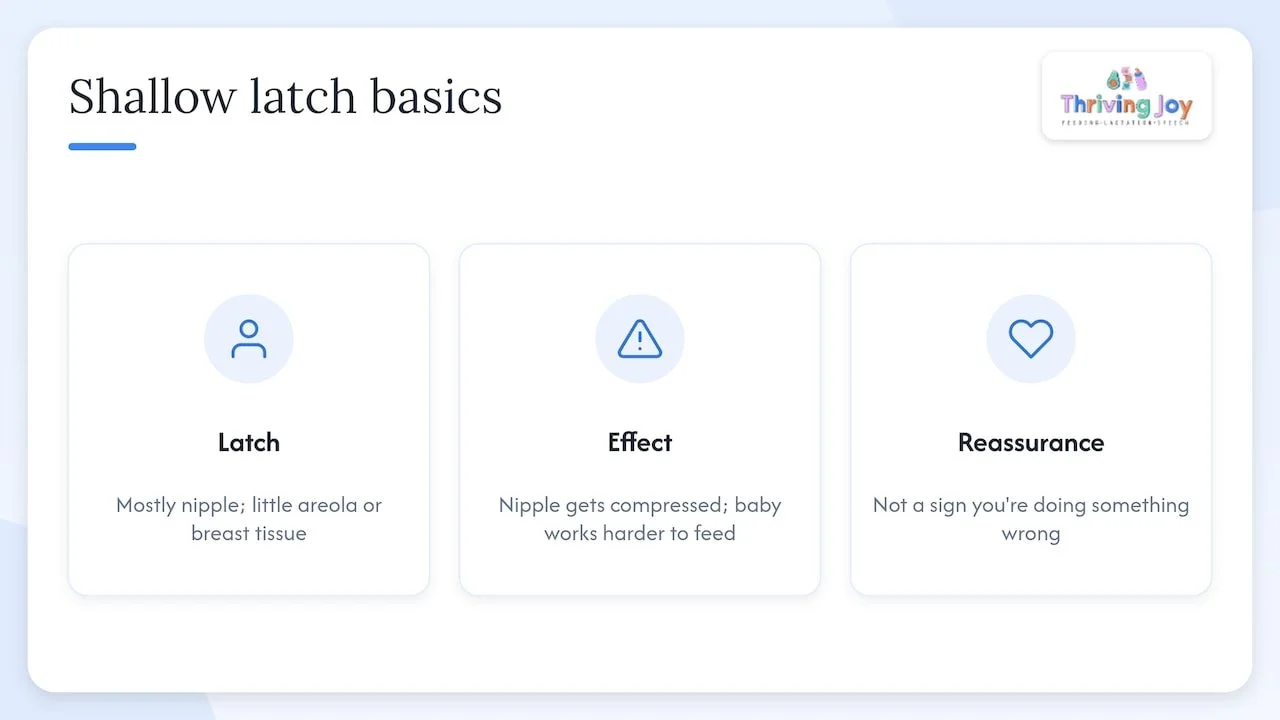
A latch is how your baby's mouth attaches to your breast. In a shallow latch, your baby takes mostly the nipple and little of the areola or surrounding breast tissue. The nipple doesn't reach far enough back in the mouth, so it gets compressed, and your baby may have to work harder to pull milk out.
This is very common in the early days. Both of you are learning, and babies are born with reflexes, not experience. A shallow latch is not a sign that you're doing something wrong or that your baby can't nurse. It's information, and it points to a small change worth making.
Signs of a shallow latch you can feel
Your body is often the first alarm. According to the CDC's newborn breastfeeding guidance, a shallow latch is often indicated by nipple pain and by cracked or bleeding nipples. Pay attention to:
Pinching or pain that lasts through the feed. Some tenderness in the first few seconds can happen early on. Pain that continues, or sharp, stabbing or burning pain, deserves a closer look. Womenshealth.gov explains that if breastfeeding hurts, your baby may be sucking only on the nipple.
Cracked, bleeding or blistered nipples. These are signals that the nipple is taking friction it shouldn't.
A flat, creased or misshapen nipple after a feed. Some parents describe it as looking like a new lipstick. That shape change tells you the nipple was squeezed.
Breasts that still feel full after nursing. If your baby isn't drawing milk out well, you may notice swelling or engorgement.
If pain is what brought you here, our guide to what to do right now for nipple pain has practical steps for comfort and care.
Signs of a shallow latch you can see and hear
Watch your baby's face and mouth, and listen during the feed. The CDC lists several cues: your baby suckles only the nipple instead of the areola, the lips are curled inward instead of flanged out, and you may hear clicking sounds. Your baby may also come off the breast often.
Here is a simple checklist to run through:
Lips tucked in. Lips should rest turned outward, like a fish. Tucked-in lips are worth gently correcting.
Mouth not wide. A small, pursed or half-open mouth at the breast usually means a smaller bite.
Clicking or smacking. Suction is breaking and re-forming, which is often what you hear.
Dimpled cheeks. Cheeks that pull in with each suck can mean the seal isn't holding.
Slipping off or popping off. A baby who keeps losing the breast may be reaching for a deeper hold.
Fussing at the breast. A baby who seems hungry but frustrated may not be getting milk easily.
Some parents also notice a baby who feeds very frequently, seems gassy or fussy, or doesn't gain weight as expected. One breastfeeding resource links shallow latch with these issues. Gas and fussiness have many possible causes, so use them as a prompt to look at the latch, not as a diagnosis.
Deep latch vs. shallow latch: how they compare
Seeing the two side by side makes it easier to spot the difference. The descriptions below draw on guidance from USDA WIC breastfeeding support, Womenshealth.gov and the American Academy of Pediatrics' HealthyChildren.org.
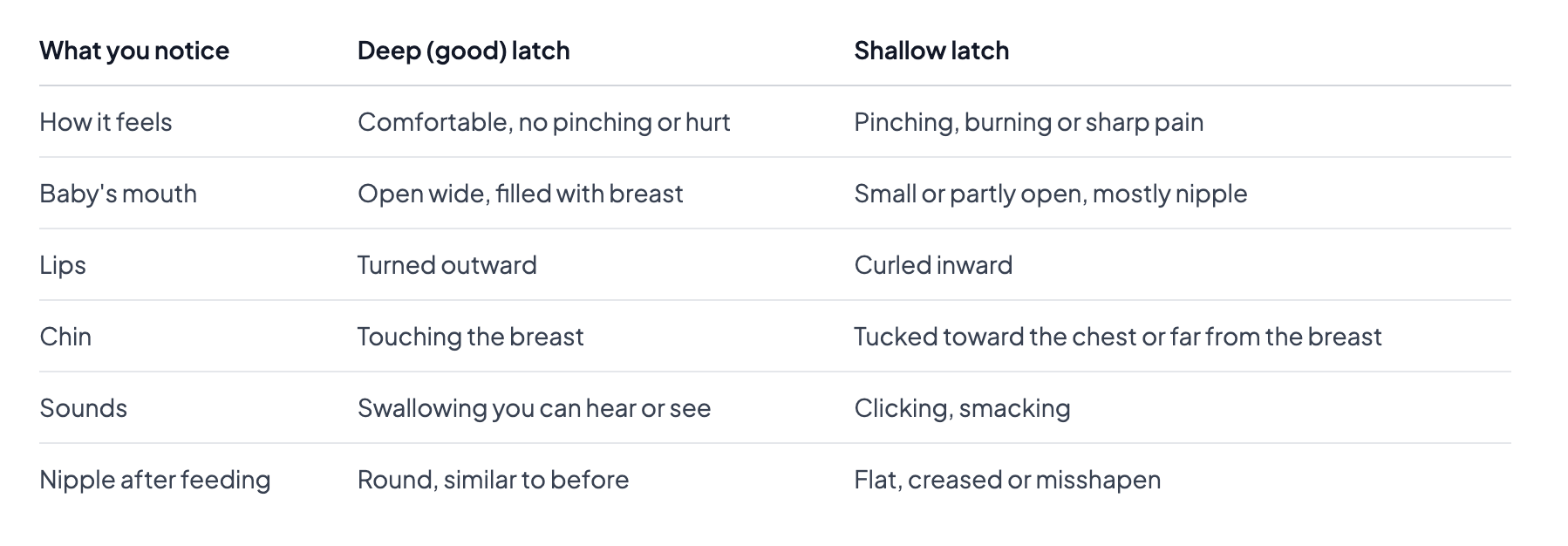
A deep latch doesn't mean perfectly silent or pain-free every second in the first days. It means the overall feel is comfortable and your baby is swallowing. If you can hear or see swallowing, that's a reassuring sign.
Is it a shallow latch or a fast letdown?
Many parents search for "fast letdown" and "forceful letdown" because the two can look similar from the outside. Both can involve a baby who pulls away, gets fussy or sounds like they're struggling at the breast. The cause is different, though.
With a fast or forceful letdown, milk comes quicker than your baby can manage. HealthyChildren.org explains that the surge can be more than a baby can coordinate with sucking, swallowing and breathing. Your baby may pull away, cry, cough or choke.
Here are some clues that can help you sort out which is more likely:
Timing. Coughing, gulping or pulling off in the first minute or two, when milk is spraying, points toward letdown. Pain and clicking that continue through the whole feed point toward latch.
Where it hurts. Nipple pinching and damage are more typical of a shallow latch.
What you see. Milk spraying from the breast when your baby pulls off suggests a strong letdown.
The two can happen together. A baby who is overwhelmed by flow may clamp down or pull back to cope, which can look like a shallow latch. That's why it helps to look at both.
For a fast letdown, HealthyChildren.org suggests pausing until the spray eases before relatching. The Mayo Clinic notes that a laid-back position can help when milk is released quickly. Leaning back lets your baby rest on your body and gives them more control over the flow.
Why babies end up with a shallow latch
There is rarely a single cause. Common contributors include:
Positioning. If your baby's head is tucked or their body is held stiffly, they can't open wide and move freely. The Mayo Clinic says your baby's chin should not rest on their chest, so there's room to swallow.
Fatigue or sleepiness. Newborns who are drowsy may take a lazy, shallow hold.
Fast flow or an overfull breast. Baby may clamp down to control the milk.
Oral structure. A high palate, a lip tie or a tongue tie can make a deep seal harder. We explain this in our posts on latch fixes for high palates and on four signs a lip tie affects breastfeeding.
Muscle tension. Tightness in the neck, such as torticollis, can make it hard for a baby to turn and open wide on one side. See our parent guide on nursing with torticollis.
If your baby has a feeding tube or has needed medical support with eating, the picture can be more layered. Learning about oral aversion in tube-fed children can help you recognize what you're seeing and know when to ask for more support.
How to fix a shallow latch at home
Small changes often make a real difference. Try these in order, and be patient with yourself. Several attempts in a feed is normal.
Get comfortable first. Support your back and arms. Tension in your shoulders tends to travel to the baby.
Bring baby to you. Hold your baby tummy to tummy, with their ear, shoulder and hip in a line. Avoid leaning forward and pushing your breast into their mouth.
Keep the chin free. The Mayo Clinic advises that the chin shouldn't rest on the chest. A slightly lifted chin helps the mouth open wider.
Wait for a wide mouth. Touch your nipple to your baby's upper lip or nose and wait for a big, open mouth, like a yawn. Then bring baby in quickly, chin first.
Check the signs. Lips out, chin touching the breast, nose close but not squashed. Womenshealth.gov describes this fit and feel.
Break suction and try again if it hurts. The same Womenshealth.gov page recommends gently sliding a clean finger into the corner of your baby's mouth to release the seal, then relatching. Don't pull your baby off without breaking the suction first.
Try a different hold. The Mayo Clinic describes the cross-cradle hold, where you support the baby's head and guide the mouth to the breast without bending forward. A laid-back position is another option, and it's especially useful with a fast letdown.
We lay out more detail in 7 breastfeeding latch techniques to try at home and in our guide to newborn breastfeeding positions.
Does a shallow latch fix itself?
Sometimes it improves as your baby grows, gains strength and learns, and as you both get more practice. But if you're in pain or damaged, waiting it out isn't the kind choice for you. Pain is a signal to adjust the setup now, and to ask for hands-on help if the adjustments don't bring relief.
Is it normal for a baby to tuck their chin?
The Mayo Clinic says the chin shouldn't rest on the chest during feeding. If your baby's chin is tucked, bring them closer and lift the head slightly so the chin leads. If your baby seems to prefer one side, or turning is hard, ask about it. Tightness in the neck is something a professional can look at.
How to know your baby is getting enough milk
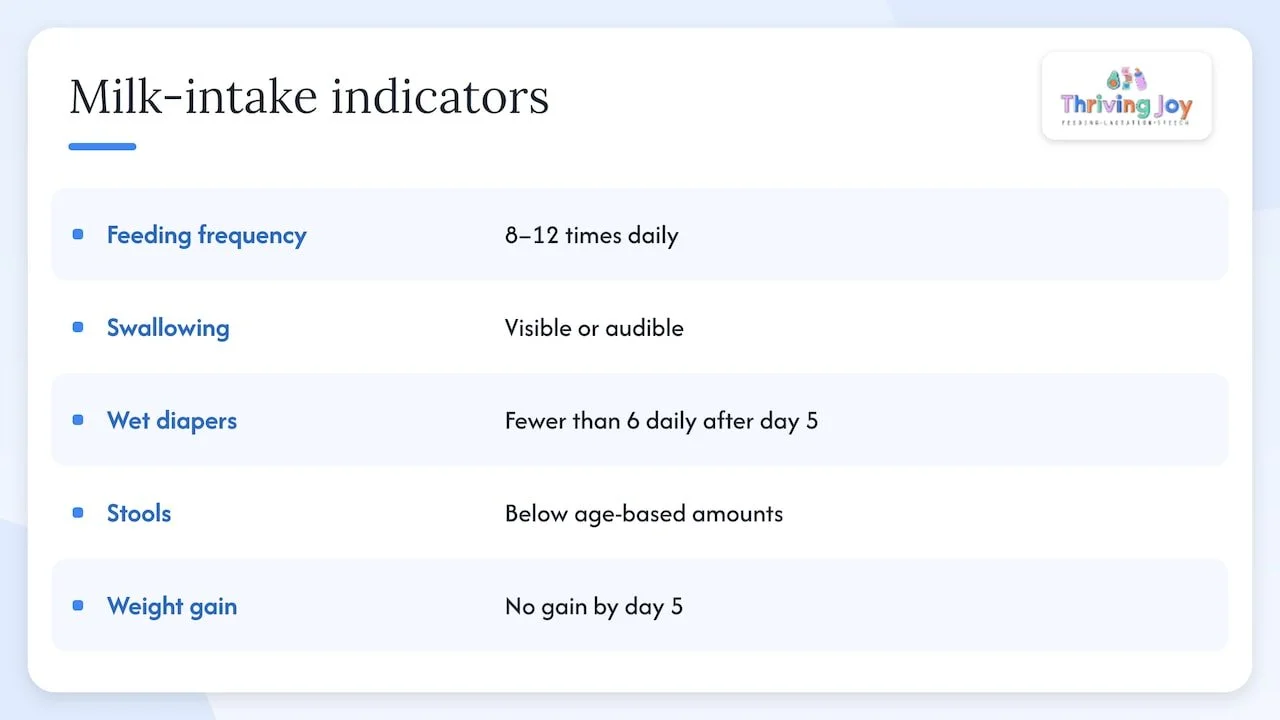
Latch is a means to an end. What matters most is that your baby is fed and growing. The CDC says that breastfeeding eight to twelve times a day, and seeing or hearing your baby swallow, are signs your baby is getting enough to eat.
Pay attention to diapers and weight too. HealthyChildren.org advises contacting a doctor if your baby has trouble latching, if breastfeeding is painful, if wet diapers number fewer than six a day after day 5, if stools are below the age-based amounts they list, or if your baby doesn't seem to be gaining weight by day 5. Those thresholds are worth keeping handy in the first week.
When to call for help
You don't need to wait until things are hard. Reach out if:
Nursing hurts at most feeds even after you've adjusted position and latch.
Your nipples are cracked, bleeding or blistered, or you see signs of infection.
Your baby has trouble latching or keeps coming off.
You're unsure your baby is getting enough milk. Womenshealth.gov suggests talking with a lactation consultant or pediatrician in that case.
Diapers or weight gain are off the pattern described above. Call your baby's doctor.
A lactation consultant can watch an entire feed, see how your baby's mouth moves and tailor suggestions to your body and your baby. If you're not sure what to bring to that visit, we put together three things to ask at a lactation consultation. If you're expecting, a prenatal lactation consultation lets you learn positioning and latch before the baby arrives.
If feeding difficulties extend beyond the breast, such as gagging, refusing textures or very slow feeds, our overview of feeding red flags in babies can help you decide what's next.
Our perspective on latch trouble
At Thriving Joy, we meet many parents who've been told to "just push through" the pain or who blame themselves for a latch that won't cooperate. We don't see it that way. A shallow latch is a clue, and our job is to help you find what's behind it.
We take a holistic, family-centered approach. That means looking at the whole picture: how you're positioned, how your baby's mouth and body move, what the feeds feel like for you, and what the days look like for your family. We aim to understand root causes instead of reaching for a quick fix, because lasting comfort tends to come from understanding why the latch is shallow in the first place.
Our founder brings a pediatric healthcare background together with her own parenting experience, so we know how tender and tiring these weeks are. Our support is designed to build your confidence as much as your baby's skills. We also work with feeding and speech needs, so if latch trouble is part of a bigger feeding picture, your care stays connected.
You deserve support that feels warm and practical. That is what we aim to give every family.
Thriving Joy
Get hands-on latch support in Pasco and Hillsborough Counties
If you'd like someone to watch a feed with you and help you adjust, our lactation counseling includes prenatal education and postpartum breastfeeding support. We also offer therapy in different settings, including the office, your home, daycare or preschool, depending on what works for your family. We accept private pay, major health insurance plans and scholarships. For parents who want to learn alongside others, our parent coaching and group workshops cover feeding and communication strategies.
FAQ
How do I know if my baby is latched well?
A good latch feels comfortable, without pinching or pain. Your baby's mouth is wide open and full of breast, the lips are turned out, the chin touches your breast, and you can hear or see swallowing. If any of these are missing, gently break suction and try again.
What are the symptoms of a shallow latch for a parent?
Most often it's nipple pain, cracked or bleeding nipples, and a nipple that looks flat or misshapen after feeding. You may also hear clicking and notice your baby coming off the breast often. If the pain continues despite repositioning, contact a lactation consultant.
Can fast letdown be mistaken for a poor latch?
Yes, because both can make a baby pull away or fuss. With a fast letdown, babies may cough or choke as milk surges, and HealthyChildren.org suggests pausing until the spray eases before relatching. A laid-back position can also help. A lactation consultant can tell you which one you're dealing with.
When should I worry about my baby's latch?
Call your baby's doctor if feeding is painful, latching is hard, wet diapers are fewer than six a day after day 5, or weight gain seems off. If you're simply unsure your baby is getting enough, a lactation consultant or pediatrician can check.
Sources
Steps and Signs of a Good Latch, USDA WIC Breastfeeding Support
A Breastfeeding Checklist: Are You Nursing Correctly?, HealthyChildren.org
Breast-Feeding Questions, HealthyChildren.org symptom checker
The information provided in Finding Joy's blog articles is for educational and informational purposes only and is not intended as medical advice, diagnosis, or treatment. Content should not be used as a substitute for professional medical advice from a qualified healthcare provider. Always consult your physician or healthcare professional regarding any medical condition, symptoms, medications, or treatment options.