


A bottle nipple's flow rate is how fast milk moves from the nipple into your baby's mouth. The right one is the one your baby can manage comfortably, and that is not always the one the package suggests for their age. Labels like "slow," "level 1" or "stage 2" are not standardized across brands. Your baby's cues are a better guide than the number on the box.
If you are standing in the baby aisle (or staring at a bottle your baby keeps pushing away), this guide explains what the labels mean, how to read your baby's signals, and when a flow question is really a feeding question. At Thriving Joy Pediatric Therapy, we help families in Pasco and Hillsborough Counties with exactly these mealtime puzzles.
Thriving Joy
Find Support for Feeding Challenges
If bottle flow changes do not ease feeding, Thriving Joy offers family-centered pediatric feeding therapy focused on your child’s needs.
TL;DR
Flow labels (slow, medium, fast, or levels 0 to 3) are set by each brand, so a "slow" nipple from one maker can flow like a "medium" from another.
Most babies born around their due date can start with a newborn flow, such as level 1 or slow flow, and babies who also breastfeed often do best with a slower one.
Gulping, coughing, milk leaking from the mouth and pulling away suggest the flow is too fast. Collapsing the nipple, very long feeds and fussing suggest it may be too slow.
Never cut or enlarge a nipple hole. Move up one level at a time, only when your baby shows you they are ready.
If changing the flow does not settle feeding, a feeding assessment can look at the coordination of sucking, swallowing and breathing.
What flow rate actually means
Flow rate is the speed at which breast milk or formula moves from the nipple into your baby's mouth. Brands label it with words such as preemie, slow, medium or fast, or with numbers like 0, 1, 2 and 3. Nearly every brand also attaches an age range to each level, according to Nationwide Children's Hospital.
The trouble is that those names are marketing categories, not measurements. Consumer Reports notes there is no industry standard for "slow" flow, and quotes a lactation consultant explaining that one brand's slow flow is about the same as another brand's medium-flow level 2.
How much brands really differ
Researchers measured milk flow from 26 bottle nipples sold to families after hospital discharge. In that 2016 study, the slowest nipple delivered 1.68 mL per minute and the fastest delivered 85.34 mL per minute. Twelve nipples averaged under 10 mL per minute, and only two averaged more than 30.
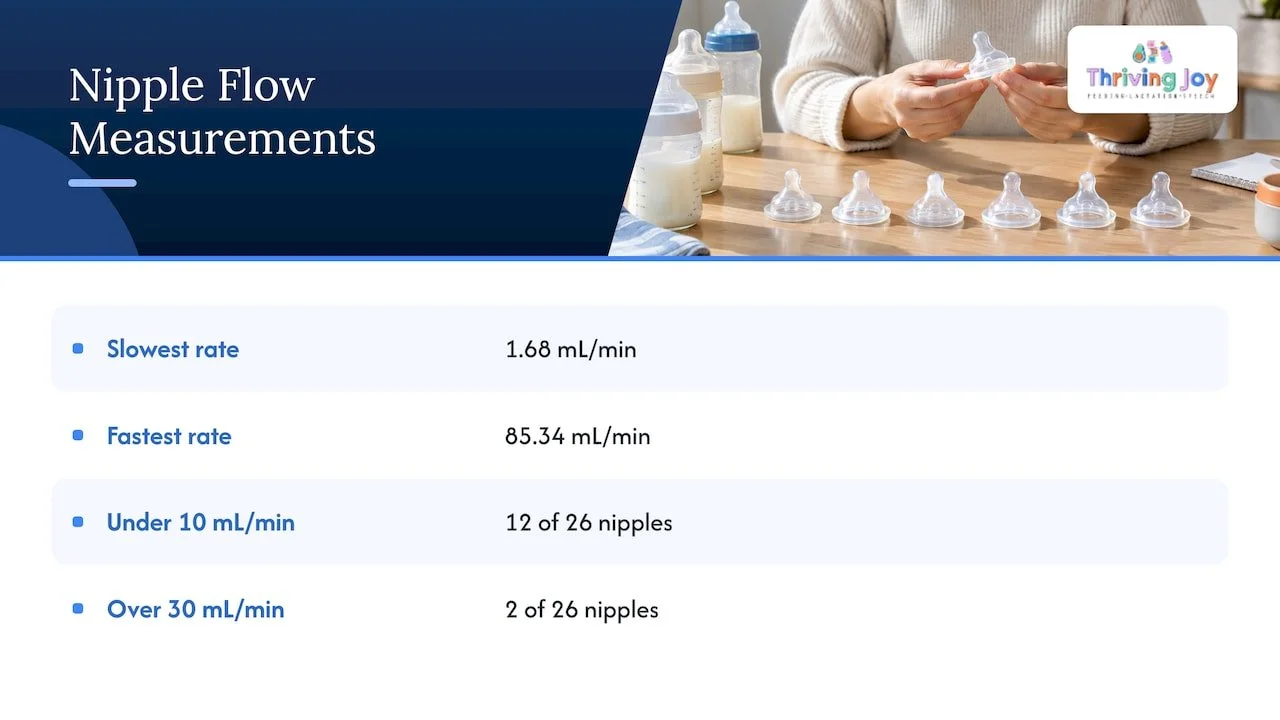
Even the same brand and label did not guarantee the same flow. Two nipples from one maker, both labeled newborn flow for 0+ months with one hole, flowed at significantly different rates. So when you switch bottle styles, treat the new nipple as a new unknown, even if the label matches.
A rough map of flow categories
Health authorities sometimes group nipples into extra slow, slow, medium, fast and very fast. Alberta Health Services publishes a table based on the same research, placing nipples marketed for 0 to 3 months in the slow range and some "level 2" nipples for 3+ months in the medium range.
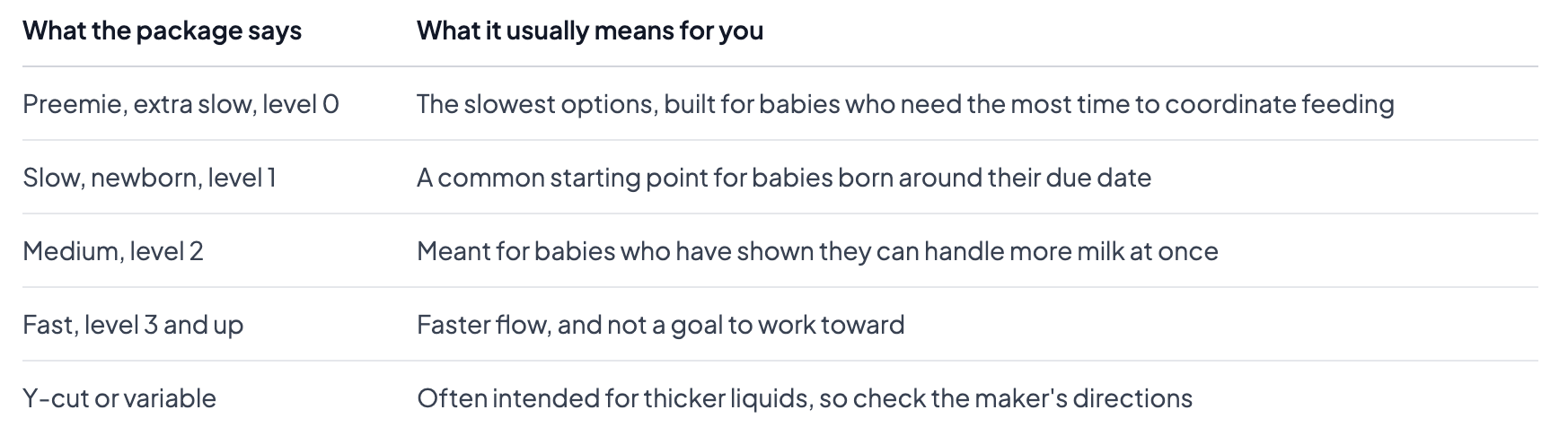
Use the table as a vocabulary guide, not a rulebook. Your baby's response is what tells you whether a nipple fits.
Choosing nipple size by age (and when age is the wrong guide)
The age ranges on packaging are a starting guess. According to Nationwide Children's Hospital, if your baby is healthy, growing and enjoys their bottle, there is no need to move up a level just because they have a birthday. Some babies stay on the same level for the whole time they use a bottle. Each baby has a feeding style, and their pace may not match the age printed on the box.
MedlinePlus explains that infants usually begin with a smaller hole and slower flow, and the size increases as the baby gets better at feeding and takes in more. It also says that choking or spitting up is a sign the flow is too fast.
A useful starting framework:
Newborns to a few months: Begin with a slow or level 1 nipple. Most babies born around their due date do well here.
Babies who breastfeed and bottle feed: A slower flow is usually the better choice, no matter how old they are, according to Parents.
Babies born early or with a health condition: Their needs may not match any age label. Talk with your pediatrician or a feeding specialist before changing the plan.
Older babies: Move up only when the cues below say the current nipple has become frustrating, not simply because the age range has arrived.
Signs the flow is too fast
This is the problem we hear about most, and it is easy to miss because a fast flow can look like an enthusiastic eater. Nationwide Children's Hospital lists gulping, choking, hard swallowing, coughing, increased drooling and refusing to eat. A Dr. Brown's Medical selection guide adds milk leaking from the mouth, pulling away from the bottle and swallowing extra air.
Watch for these during a feed:
Milk dribbling out the corners of the mouth
Gulping or swallowing fast without pausing to breathe
Coughing, gagging or choking
Wide, alarmed eyes or a look of distress
Squirming, or pushing the bottle away
Short, frantic feeds followed by big spit-ups
Can a fast flow cause gas?
It can contribute. A fast flow can lead a baby to gulp and swallow air, which may add to gas and spit-up. Boston Medical Center also notes that because bottles flow quickly, some babies keep sucking after they are full, which can lead to overfeeding. If your baby seems gassy after most bottles, flow is worth checking before anything else.
What to do in the moment
You do not need to end the feed. Trans Care BC suggests tilting the bottle to drain milk from the nipple, or pausing to burp and cuddle. If stress signs keep appearing, try a slower-flow nipple or a different bottle shape. Our guide to paced bottle feeding walks through how to hold the bottle and break the feed into calm pauses, which helps at any flow level.
Signs the flow is too slow
Slow flow gets less attention, but it matters too. Nationwide Children's Hospital describes taking longer to finish, fast sucking with few swallows (the nipple may collapse), and getting fussy while eating as signs your baby may be ready for a faster nipple. The Dr. Brown's Medical guide adds arching away, crying, tiring quickly, biting or chewing the nipple and giving up before taking enough.
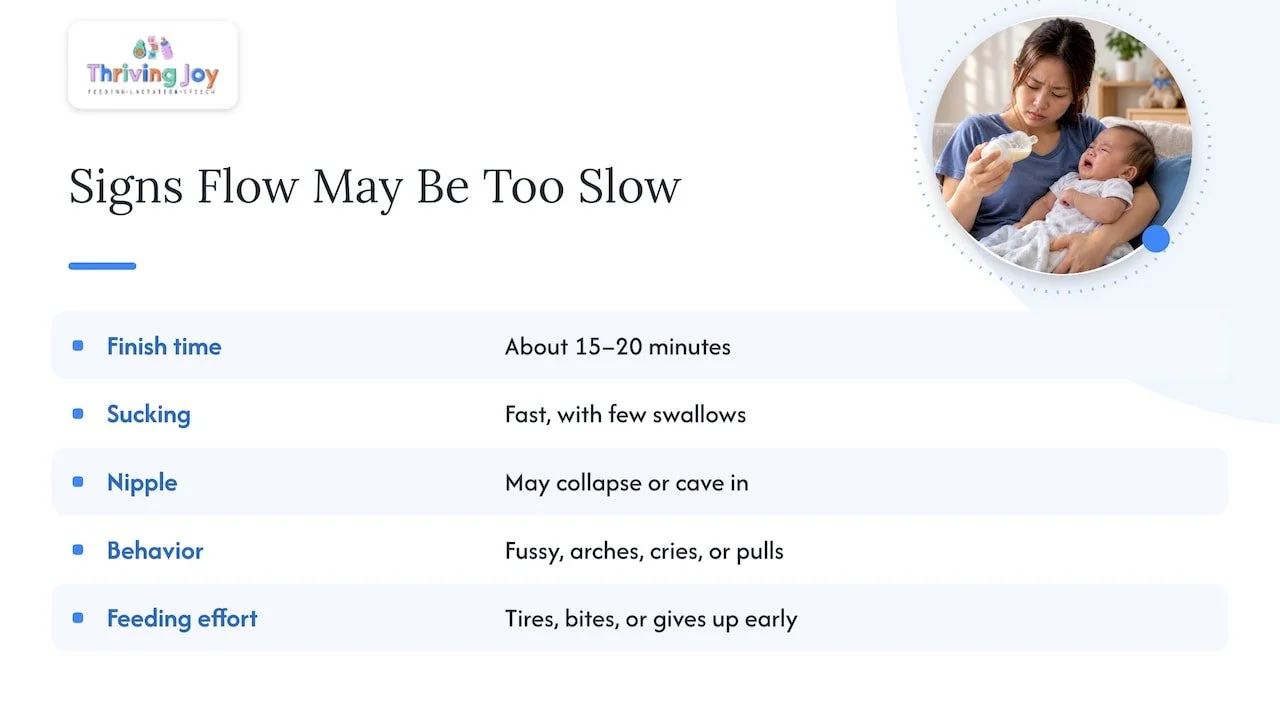
Boston Medical Center's guidance says a baby should finish in about 15 to 20 minutes without sucking too hard, and the nipple should not cave in. Lurie Children's Hospital similarly suggests moving up when your baby pulls at the bottle or collapses the nipple.
How to move up a level
Confirm it is the nipple. Check that the nipple is not clogged, the collar is not screwed on too tight and the bottle is venting as designed.
Change one thing. Go up a single level rather than jumping to fast flow.
Give it a fair trial. Lurie Children's Hospital suggests trying a bottle for two to three days before judging it, and avoiding constant swapping once you find one that works.
Watch the same cues. If gulping or leaking appears, you have gone too far, so step back.
Please do not cut the nipple
It is tempting to snip a hole bigger when a feed drags on. Boston Medical Center warns that cutting, widening or adding holes can lead to choking, overfeeding or swallowing air, which can cause gas or colic. Buy the next level instead.
Flow, breastfeeding and bottle preference
Flow does not only affect comfort at the bottle. A lactation consultant quoted by Parents explains that a faster-flow nipple can make milk so easy to get that a baby may begin refusing the breast, since the bottle gives more milk for less effort.
If you are combining breast and bottle, a slow-flow nipple and paced feeding help your baby keep working at the breast the way they need to. A simple feeding log for latch problems can also show you patterns across feeds, such as which bottles went smoothly and which did not. If your baby has started preferring the bottle, our articles on nipple confusion in newborns and teaching a newborn to take a bottle offer gentle steps to try at home.
When flow is not the whole story
Most flow troubles ease with a nipple change and calmer pacing. Sometimes they do not. Dr. Brown's notes that if you adjust the flow and your baby still struggles, there may be an underlying feeding-coordination issue, and an assessment with a qualified specialist can help.
The 2016 research team made a related point: many healthy full-term babies are resilient and can handle differences between nipples, but the wide range in flow may matter a great deal for fragile infants, and the label on a nipple does not tell parents enough to choose well.
Contact your pediatrician promptly if your baby was born early or has a health condition, repeatedly refuses feeds, has fewer wet diapers than expected, seems unusually sleepy, seems to be in pain or is not gaining weight as expected. These are reasons to call, not to keep experimenting with nipples.
They are also the moments when a feeding therapist is a natural next step. Our piece on helping your baby through bottle feeding struggles describes what that can look like.
How we approach flow at Thriving Joy
Parents often come to us after trying every nipple on the shelf. We understand the frustration, because a nipple swap feels like it should be the fix. Sometimes it is.
When it is not, we look at root causes rather than quick fixes: how your baby coordinates sucking, swallowing and breathing, how they are positioned, and how feeds feel for both of you. Our approach is holistic and family-centered, and it draws on pediatric healthcare experience and our founder's own experience as a parent.
That is why we do not hand you a chart and a brand name. We watch a feed, work out what your baby is telling us, and build a plan that fits your family. We can meet you in our office, at home, or at daycare or preschool, wherever mealtimes actually happen.
Thriving Joy
Getting hands-on help
If you are in Pasco or Hillsborough County and bottle feeds still feel stressful, we can help. Feeding therapy looks at the whole picture of your baby's feeding, and lactation counseling supports families who are combining breast and bottle. Our parent coaching and workshops cover starting solids, picky eating and feeding support groups. We accept private pay, major health insurance plans and scholarships.
A quick checklist for your next feed
Hold your baby semi-upright and keep the bottle only slightly tilted.
Let your baby draw the nipple in rather than pushing it into their mouth.
Pause every few sucks, so they can breathe and show you whether they want more.
Check for the cues above: leaking, gulping and pulling away on one side, collapsing and fussing on the other.
Change one thing at a time, and give it a few days before deciding.
Write down what you see. Patterns are far easier to spot on paper at 3 a.m.
FAQ
When should I switch to a level 2 nipple?
Switch when your baby shows you the current nipple is too slow: feeds take much longer, the nipple collapses, or they get fussy and tug at the bottle. Age alone is not a reason. A healthy, growing baby who enjoys their bottle can stay on the same level.
My bottle nipple flow is too slow. What should I do?
First check that the nipple is not clogged or the collar too tight. Then move up just one level and give it two to three days. Do not cut the nipple, since that can cause choking and swallowed air.
Can too fast a flow cause gas?
Yes, it can add to it. Gulping lets a baby swallow extra air, which may mean more gas and spit-up. A slower nipple and paced feeding often help.
How can I tell if the flow is too fast?
Look for coughing, gagging, gulping, milk leaking from the mouth, pulling away or a distressed look. If you see these, tilt the bottle down to slow the milk, take a break to burp, and try a slower nipple.
Sources
Milk flow rates from bottle nipples used after hospital discharge, 2016
How to Find the Right Baby Bottle Nipple Flow, Consumer Reports
The information provided in Finding Joy's blog articles is for educational and informational purposes only and is not intended as medical advice, diagnosis, or treatment. Content should not be used as a substitute for professional medical advice from a qualified healthcare provider. Always consult your physician or healthcare professional regarding any medical condition, symptoms, medications, or treatment options.