

Early Intervention Speech Help: What to Do Right Now

Early intervention speech services are federally funded speech-language supports for babies and toddlers, delivered through your state's IDEA Part C program, that help children build communication skills before age 3. If you're worried about your child's talking, babbling, or understanding right now, the single best move is to contact your state or territory Early Intervention program directly, either by phone or through their online referral form. You don't need a diagnosis, a doctor's note, or even certainty that something is wrong. You just need a concern.
Your pediatrician can also make a referral or point you toward the right office if you're not sure where to start. Either path works, and both are free to use. The Centers for Disease Control and Prevention (CDC) is clear on this point: any concerned parent or caregiver can request an evaluation for a child from birth to 3, no referral required. Locally in the Tampa area, families can also reach out to Thrivingjoy, which works alongside state Early Intervention services and offers private speech therapy for toddlers who need it. But the state program should be your first call, because for eligible children, it's free or low cost, and it's designed to move fast once you make contact.
Key Takeaways
Early intervention speech services work best when families act on early signs quickly, combine state Part C resources with hands-on caregiver coaching, and treat everyday routines as therapy opportunities rather than waiting for scheduled sessions alone.
PointDetailsContact is free and fastAny parent can call their state Early Intervention program directly, no doctor's referral required.Watch age-based thresholdsNo words at 18 months or fewer than 30 words at between 18 and 30 months are recognized signals for evaluation.Services come to your childSessions typically happen in the home or daycare, not a clinic waiting room.IFSP goals are measurableA good plan states specific, trackable outcomes, not vague language like "improve speech."Thrivingjoy adds a private optionFamilies can pair state services with Thrivingjoy's family-coaching speech therapy for faster, more individualized support.
Table of Contents
How Do You Know If Your Child Qualifies for Speech Intervention?
What Does Early Intervention Cost, and What Does Insurance Cover?
What Is Early Intervention (Part C), and How Does It Work?
Early Intervention is a federally mandated program under IDEA Part C that provides speech-language pathology and other developmental services to eligible infants and toddlers from birth to age 3. Every state and territory runs its own version of this program, publicly funded so that eligible families pay nothing or very little out of pocket.
What makes Early Intervention different from a typical clinic visit is where and how it happens. Services come to your child, not the other way around. A speech-language pathologist (SLP) might sit on your living room floor during snack time, or work alongside your child's daycare teacher during circle time, because the whole philosophy rests on delivering support inside your child's actual daily routines rather than in an unfamiliar office.
The team behind this work is usually broader than most parents expect. Depending on your child's needs, you might interact with:
A speech-language pathologist, who assesses communication and coaches caregivers on strategies
An audiologist, if hearing is a factor in the speech concern
A service coordinator, who manages paperwork, scheduling, and communication between providers
Occupational or physical therapists, if motor development also needs support
You, the parent or caregiver, who is treated as a full member of the team rather than a bystander
This last point matters more than it might seem. ASHA's Practice Portal on Early Intervention emphasizes a family-centered, coaching-based model, where the SLP's real job is teaching you the strategies that fit naturally into bath time, mealtime, and playtime. It's a shift from "the therapist fixes the problem" to "the therapist equips the family," and it tends to produce results that stick because the strategies live in your home long after the session ends.
How Do You Know If Your Child Qualifies for Speech Intervention?
Any child with a genuine communication concern deserves an evaluation, but certain age-based patterns tend to signal that a delay is more than a "late bloomer" phase. Clinical guidance points to specific thresholds that speech-language pathologists use to flag when intervention is likely to help.
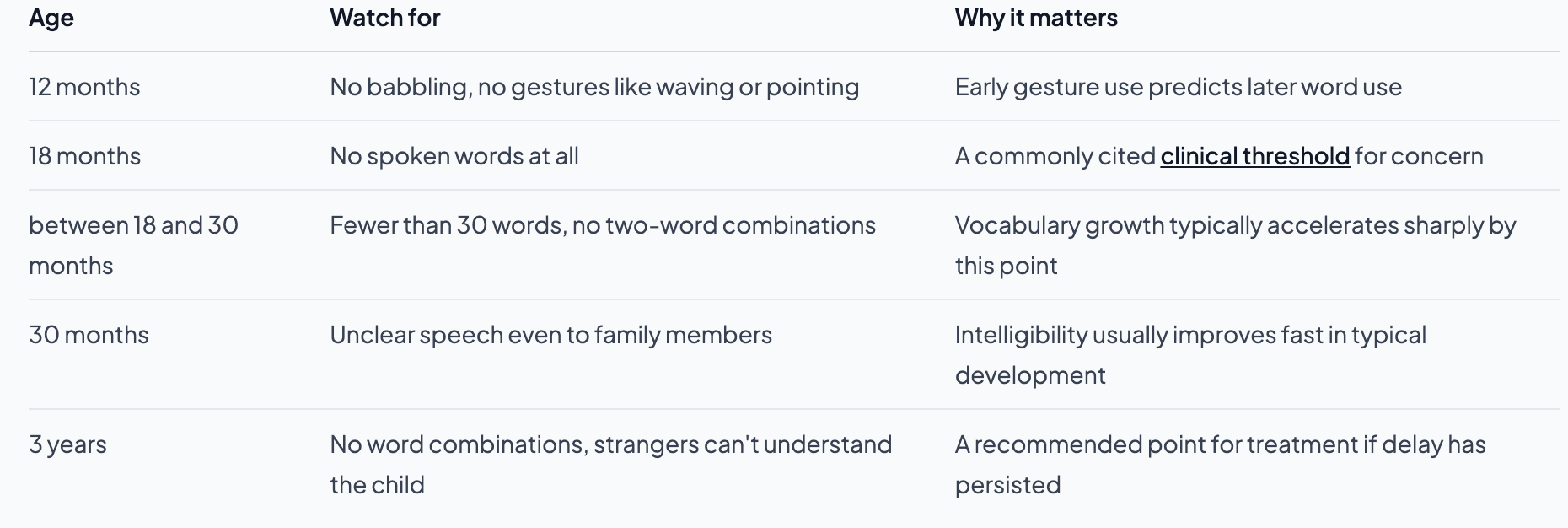
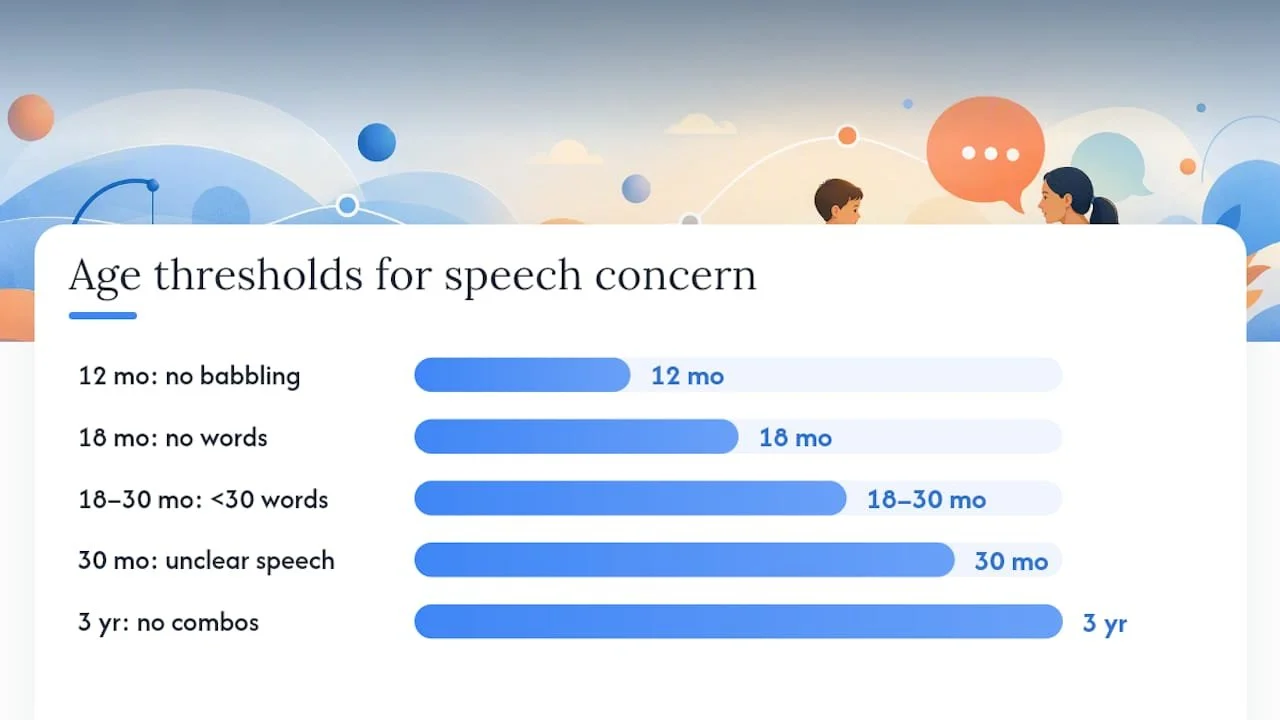
If your child fits the profile of a late talker, meaning good understanding and social skills but a limited spoken vocabulary between 18 and 30 months, don't assume it will resolve on its own. The Hanen Centre notes that while many late talkers catch up, an estimated 20 to 30 percent continue to have language difficulties. That's a real enough chance that waiting isn't a neutral choice.
A few things worth knowing about who can start this process and who typically qualifies faster:
Any parent, grandparent, daycare provider, or pediatrician can make a referral. You don't need professional credentials to raise a concern.
Eligibility is ultimately determined through a formal evaluation, not a checklist you fill out yourself.
Children with an established diagnosis, such as Down syndrome, autism, or certain genetic conditions, often qualify for services automatically without needing to demonstrate a measurable delay first.
If you're already noticing warning signs beyond speech, like limited eye contact or unusual play patterns, it's worth reading more on early warning signs of speech delays so you have language for what you're observing when you make that first call.
How to Get Early Intervention Speech Services
The process is more straightforward than most parents expect. It generally moves through five steps.
Contact your state or territory Early Intervention program. Search "[your state] Early Intervention Part C" or ask your pediatrician for the local office name. Every state runs a public program, and pages like Pennsylvania's Department of Human Services or California's Early Start show what a typical state system looks like.
Describe your specific concerns clearly. Say what you're seeing: "My 20-month-old has fewer than 10 words" or "My son doesn't respond when I call his name." Specifics move the process faster than general worry.
Complete the referral intake. A service coordinator will collect basic information and schedule a full evaluation, usually within a few weeks depending on your state's caseload.
Attend the evaluation. A team, often including the SLP, observes your child, uses standardized assessment tools, and talks with you about daily routines and concerns.
Review the eligibility decision. If your child qualifies, the team schedules an Individualized Family Service Plan (IFSP) meeting, typically within 45 days of referral, to set goals and start services.
Before you call, gather a short list of specifics: what your child says and understands, any family history of speech or language delays, your child's daycare or babysitting schedule, and your insurance information if you have it. Having these details ready shaves real time off the intake conversation.
What Speech Services Look Like Once They Start
Early intervention speech support rarely resembles a formal "lesson." Sessions tend to be built around play, because play is where toddlers naturally practice communication without pressure.

A typical visit might involve an SLP getting down on the floor with blocks or a favorite toy, narrating actions ("up, up, block goes up"), pausing to give your child a chance to respond, and modeling words slightly beyond what your child currently says. Much of the visit is also spent coaching you: showing you how to wait after asking a question, how to expand a one-word utterance into two words, or how to use mealtime as a natural vocabulary-building moment.
Depending on your child's needs, services might include:
A speech-language screening to flag concerns quickly
A full comprehensive assessment covering both understanding (receptive language) and speaking (expressive language)
Direct one-on-one therapy sessions
Caregiver coaching sessions, sometimes without the child present
Introduction to augmentative and alternative communication (AAC) tools for children with significant expressive challenges
Delivery format varies by family and by state. Many programs offer in-home visits as the default, since natural environments are part of the Part C philosophy, while others offer center-based sessions or teletherapy, particularly useful for families in rural areas or with scheduling conflicts. If English isn't the primary language at home, ask about interpreter services early. Federal programs are required to provide language access, and a good service coordinator will arrange this without you having to push hard for it.
What Does Early Intervention Cost, and What Does Insurance Cover?
Early Intervention services under Part C are publicly funded, and many families pay nothing for evaluation and core services because the program was designed to remove cost as a barrier to early support. That said, some states apply a sliding fee scale based on income for certain ongoing services, so it's worth asking directly what your state charges, if anything.
If you're also considering private therapy alongside or instead of state services, insurance coverage becomes more relevant. Before your first call to a private provider, have these details ready:
Your insurance member ID and group number
Whether your plan is HMO, PPO, or another structure, since this affects referral requirements
Whether prior authorization is required for speech-language pathology visits
The relevant CPT codes your provider's office can supply, which insurers use to process claims
If a claim gets denied, you have options beyond accepting the decision. You can file a formal appeal with your insurer, ask your Early Intervention service coordinator whether Part C funding can cover the gap, or look into community clinics that offer sliding-scale rates based on income. None of these paths require you to give up on services because of a denial letter.
What Happens During an Evaluation and IFSP Meeting?
An evaluation is more thorough than a quick conversation, and understanding its structure helps you know what to expect walking in.
Evaluators typically combine direct observation of your child at play, standardized assessment tools appropriate for the child's age, and a detailed interview with you about developmental history and daily communication patterns. Because hearing loss can look identical to a speech delay in a young child, a hearing screening or referral to audiology is a standard part of the process when speech concerns are present.
If your child qualifies, the team builds an Individualized Family Service Plan, or IFSP, the formal roadmap for services. A complete IFSP typically includes:
Present levels of development, describing where your child currently stands in communication and related areas
Family priorities and concerns, written in your own words, not just clinical language
Measurable outcomes, such as "will use two-word combinations to request items in 4 out of 5 opportunities" rather than a vague goal like "improve speech"
The specific services, frequency, and setting where they'll be delivered
A named service coordinator responsible for keeping everything on track
Scheduled review dates, usually every six months, with a full reassessment annually
You can request a review sooner if you feel progress has stalled or circumstances have changed. The plan belongs to your family as much as it does the clinical team, and if something in it doesn't reflect your daily reality, say so at the meeting. For a deeper look at what evaluators actually assess, this breakdown of the speech-language evaluation process walks through it step by step.
What Happens When Your Child Turns 3?
Part C services end at age 3, but that doesn't mean support disappears. It shifts to a different system, and planning for that shift early prevents a gap in care.
Start transition planning around 2.5 years old. Most programs recommend beginning the conversation at least 90 days before your child's third birthday, sometimes earlier if your state requires it.
Contact your local school district. Your service coordinator should help with this, but you can also reach out directly to ask about evaluation for Part B, Section 619 preschool special education services.
Request an evaluation under Part B if your child may still need support. This is a separate eligibility process from Part C, with its own criteria, so qualifying for one doesn't automatically guarantee the other.
Attend the transition meeting. This brings together your current EI team and the school district to discuss what comes next.
Outcomes vary by child. Some children transition smoothly into preschool speech services through their school district. Others age out of Part C without meeting Part B criteria and either don't need ongoing support or continue with private therapy. Neither outcome is a failure; it reflects where your child landed developmentally by age 3. If private therapy becomes the right path, it helps to know what a good clinic looks like before you commit.
How to Choose a Private Speech Therapist or Clinic
Some families use Early Intervention exclusively. Others add private therapy alongside it, or turn to private care after transitioning out of Part C. Either way, a few criteria separate a strong provider from a mediocre one.
Start with credentials: look for a Certificate of Clinical Competence (CCC-SLP) from ASHA, and ask specifically about pediatric experience, not just general caseload experience. A therapist who has spent a decade with school-age stuttering clients may not be the best fit for a nonverbal 18-month-old. If feeding concerns overlap with speech concerns, which happens more often than most parents realize, ask whether the provider also addresses feeding, since oral motor patterns tied to eating and talking are closely connected.
On your first call, ask directly:
What does your evaluation process look like, and how long does it take?
Is your therapy model direct treatment, caregiver coaching, or a blend of both?
How long are sessions, and how often would you recommend meeting?
Do you accept Medicaid or my insurance, and what happens if coverage runs out?
Watch for red flags, too. A provider who resists involving you in sessions, offers a rigid one-size-fits-all program regardless of your child's specific needs, or can't clearly explain how they'll measure progress is worth a second look elsewhere. Strong providers welcome caregiver involvement because they know it makes the therapy work faster.
How Thrivingjoy Supports Families Through Speech Delays
Thrivingjoy takes a family-centered approach to pediatric speech therapy, built around the same coaching philosophy that underpins Part C services nationally. Every plan starts with identifying the root cause of a communication challenge rather than treating surface symptoms in isolation, because a toddler who won't combine words might be dealing with an oral motor issue, a hearing concern, or simply needing more modeling at home. Each of those calls for a different plan.
The process typically starts with an intake conversation, followed by a full assessment, then collaborative goal-setting that mirrors the IFSP structure many families already recognize from state Early Intervention. From there, caregiver coaching gets folded directly into sessions, whether that means guiding you through mealtime language strategies or showing you how to expand your child's play-based vocabulary at home. Progress gets reviewed regularly, not left until a distant annual check-in.
Pro Tip: If your child also struggles with mealtime, mention it during intake even if speech was your original concern. Feeding and communication development are closely linked, and addressing both together often speeds up progress in each.
Families typically notice the clinic's rhythm within the first 6 to 12 weeks: consistent sessions, visible caregiver coaching, and measurable goals rather than vague reassurance. Thrivingjoy also works with families on insurance questions and offers guidance on sliding-fee options for those who need it, so cost concerns don't have to be the reason a family delays getting help. For families managing feeding challenges alongside speech concerns, feeding therapy solutions often complement speech work well.
A Clinician's Perspective on What Actually Helps
The parents who see the fastest progress aren't the ones with the most therapy hours booked. They're the ones who take what happens in a 45-minute session and stretch it across an entire day of ordinary moments, snack time, bath time, the walk to the car. Therapy time is limited by definition. Daily life isn't.
One strategy worth trying immediately, even before your first appointment is scheduled, is a daily "Special Time": 5 to 15 minutes where you get down on the floor and simply follow your child's lead, no quizzing, no "what's this called?", no correcting. If your child pushes a truck back and forth, you narrate and imitate rather than redirect. This lowers the performance pressure that makes some toddlers clam up entirely, and it tends to open up more spontaneous communication than any flashcard ever will.
A second habit that pays off fast: pause after you ask a question or make a comment, and count to five in your head before jumping in. Toddlers often need that extra beat to process language and formulate a response, and most adults fill the silence before the child ever gets the chance. It feels unnatural at first. It works.
None of this replaces professional evaluation if you're seeing real warning signs. But while you wait for your first appointment, these two habits cost nothing and start building the exact skills a speech-language pathologist will reinforce later. For more structured ideas you can try today, fun speech therapy activities for toddlers offers a good starting list.
Ready to Talk to Someone? Here's Your Next Step
If you've read this far, you probably already have a specific worry in mind, not a general one. That's exactly the moment to act on it. Thrivingjoy offers a faster path than waiting on a long public program queue when you want private, one-on-one attention sooner: sessions built around your child's actual routines, direct caregiver coaching in every visit, and a plan that adjusts as your child progresses rather than staying fixed for months at a time.
Thrivingjoy works with major insurance plans and offers financial options for families who need them, so cost doesn't have to be the reason you wait. Contact the clinic directly to schedule an intake, or explore the speech therapy program for toddlers to see what a first evaluation includes. One honest note: if you haven't already contacted your state Early Intervention program, do that too. For eligible children, Part C services are free or low cost, and there's no reason not to pursue both avenues at once.
Where to Go for More Information
The IDEA Part C program page explains the federal law behind Early Intervention and how funding reaches each state. The CDC's Early Intervention resource is the clearest starting point for understanding how to self-refer and what to expect from your state's process. ASHA's Practice Portal on Early Intervention offers a detailed look at how speech-language pathologists approach family coaching, useful if you want to understand the clinical reasoning behind the sessions themselves. For milestone-specific guidance, the Hanen Centre's late talker resource breaks down what separates a late talker who catches up from one who needs ongoing support. Finally, search your own state's Department of Health or Department of Education site for your local Part C directory. Programs like Pennsylvania's Early Intervention Services and California's Early Start show what to expect, but every state runs its own contact page, and that's the one you'll actually need.
Frequently Asked Questions
Does my child need a diagnosis to qualify for early intervention speech services? No. Eligibility is determined through a formal evaluation, not a pre-existing diagnosis. Children with an established medical or genetic condition often qualify automatically, but a diagnosis isn't required to request an evaluation in the first place.
How much does early intervention speech therapy cost? Part C services are publicly funded, so many families pay nothing or a small sliding-scale fee for eligible services. Private therapy costs vary and typically involve insurance, so check your plan's coverage for speech-language pathology visits before scheduling.
What's the difference between early intervention and regular speech therapy? Early intervention is a specific federally funded program for children birth to 3, delivered through home visits or natural settings with heavy caregiver coaching. Regular speech therapy, including private clinic therapy, can serve any age and is typically delivered in a clinic or office setting.
How long does it take to start services after referral? Timelines vary by state, but most programs aim to complete evaluation and hold the IFSP meeting within 45 days of referral. Contacting your program as soon as you notice concerns keeps that clock moving in your favor.
My child is a late talker but understands everything I say. Should I still be concerned? Good understanding is a reassuring sign, but it doesn't rule out a persistent delay. Research cited by the Hanen Centre estimates that 20 to 30 percent of late talkers continue to have language difficulties, which is enough reason to get an evaluation rather than wait and see.
This article is general information, not a substitute for advice from a qualified doctor. Consult a qualified healthcare professional about your own circumstances before acting on anything here.